XStore theme

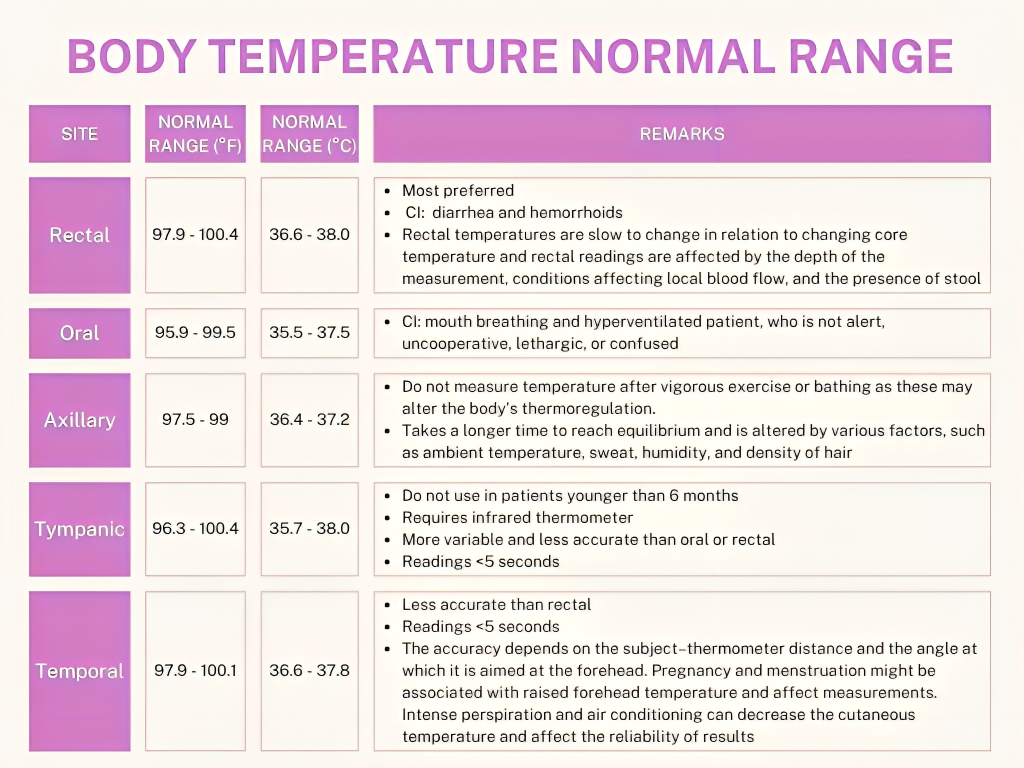
Normal body temperature

Normal temperature range is different for different sites.
Fever chart

Know Proper Technique Of Temperature Measurement!!

  • Things to remember while taking temperature
    • Temperature should be taken after 30 minutes of eating or drinking.
    • Do not measure temperature after vigorous exercise or bathing as these may alter the body’s thermoregulation.
  • Things to remember before confirming fever
    • Different sites have different cut-offs. Rectal/temporal/tympanic temp ~ oral + 0.5F to1F (0.3C-0.6C) ~ axillary + 1F to 2F
    • Reliability of measurement site: Rectal > oral > axillary. If the fever is detected by axillary method, reconfirm with alternative sites
    • Diurnal rhythm cause body temperature to naturally fluctuate during the day, with higher temperatures occurring in the late afternoon to early evening (7-9 pm) and lowest during the morning(6-8 am). Hence, if the body temperature is measured at the morning time, the fever set off limit is 0.5C lower than the standard upper limit should be considered. For example, if oral measurement is taken, fever is confirmed if the temperature is above 37C (37.5C is the standard upper cut off limit) in the morning.
    • Fever cut-off for females during ovulation, menstruation and pregnancy is higher, whereas elderly patient and patient with liver cirrhosis, renal disease, hypothyroidism, and heart failure typically have lower cut off values.
    • Before measurement, confirm if any antipyretic is used shortly (medication, dose, administration time and duration). Antipyretics will typically lower temperature by 1-2 degrees. This factor should be considered about whether self-treatment or referral is appropraite.
    • Individual difference for normal body temperature of 1.8F-2.5F (1-1.4C) has been observed. Hence, fever diagnosis should be individualized.
  •  
  •  

Assessment of fever for self-medication

-----------------------------------------------------
Does the patient satisfy any of the situations below?
  • Is the child lethargic, irritable, decreased responsiveness, poor feeding?
  • Appearance: Is the child's skin color abnormal (pale, mottled or bluish?
  • Are they not well hydrated (difficulty producing tears, urinating irregularly)?
  • Respiratory distress: The child is breathing rapidly, having difficulty breathing, or showing signs of increased work of breathing (e.g., nasal flaring, retractions)
-----------------------------------------------------
-----------------------------------------------------
-----------------------------------------------------
Is there tachycardia or tachypnea?
  • Tachycardia:
    • Is the heart rate is excessively high relative to the degree of fever (more than 10-15 beats per minute for every 1°C (1.8°F)?
    • Is tachycardia combined with weakness, dizziness, or chest pain?
  • Tachypnea (breathing rate increases with fever to meet the body's increased oxygen demand)
    • Is there Increased work of breathing (Involvement of accessory muscles, flaring nostrils, chest sinking with each breath) or cyanosis or rapid and shallow breathing?
-----------------------------------------------------

A. Does the patient have other sign of infections like: Chills, rigor, confusion or delirium, tachycardia and hypotension, fast shallow breathing, shivering

OR

B. Is the patient suspected for systemic or localized infection requiring antibiotic use? 

(Click here to learn more about assessment of body parts indicating infection)

OR

C. Does the patient have any of the matching clinical presentation for the specific infection?

(Click here to learn more about different clinical presentation for the specific infections)

-----------------------------------------------------

Has the patient been recently suffered from any infection, or hospitalized for infection, or infected during the recent hospital stay? If yes, does the patient likely to have recurred from the same infection?

-----------------------------------------------------

Does the patient has medical history of

  • Impaired oxygen utilization (e.g., severe COPD, respiratory distress, heart failure)
  • Impaired immune function (cancer, HIV)
  • CNS damage (e.g., head trauma, stroke)
  • febrile seizures or seizure
-----------------------------------------------------

Is the patient on any of the following medication?

Antibiotics, amphetamines, atropine, antihistamines, thyroid hormones, anti-neoplastics, antipsychotics, illicit drugs, TCAs, ACEI (captopril), heparin, allopurinol and others?

Drug fever is a common condition (3-5% of total fever) that is frequently misdiagnosed. It is a febrile response that coincides temporally with the administration of a drug and disappears after discontinuation of the offending agent. Drug fever is usually suspected when no other cause for the fever can be elucidated, sometimes after antimicrobial therapy has already been started. In nonsensitized individuals receiving a drug for the first time, the onset of fever is highly variable and differs among drug classes, but most commonly appears after 7–10 days of drug administration and rapidly reverses after discontinuation of the drug. Early diagnosis may reduce inappropriate and potentially harmful and expensive diagnostic and therapeutic interventions. Rechallenge with the offending agent will usually cause recurrence of fever within a few hours, confirming the diagnosis. Rechallenge is controversial and should be performed with extreme caution, since there is a potential for a more severe drug reaction.

Recommendation: Require medical referral

Rational: 

Children, especially those under 6 months, are treated with more caution because

  • Immune System Immaturity: Young infants have developing immune systems, making them more vulnerable to serious infections. What might be a mild virus in an older child can quickly become a severe illness in a baby.
  • Difficulty in Assessment: Babies can't clearly communicate their symptoms. A seemingly "just a fever" could be a sign of a more significant problem like meningitis, a urinary tract infection, or sepsis.
  • Risk of Serious Infections: Young infants are at higher risk for bacterial infections that can be life-threatening. Prompt diagnosis and treatment with antibiotics are crucial in these cases.
  • Temperature Regulation: Newborns, in particular, have less developed temperature regulation systems, which can make it harder for them to control their body temperature.

Recommendation: Require medical referral

Rational: 

This child require further evaluation because

  • Temperature is just one factor: While temperature readings are important, they don't tell the whole story. A child's overall condition is equally, if not more, important.
  • Compensatory mechanisms: In some cases, especially in very young infants, the body might not mount a high fever even with a serious infection. This could be due to their immature temperature regulation systems.
  • Severity of illness: Some serious illnesses may not always present with high fever. For example, sepsis in a newborn might present with subtle temperature changes but significant changes in behavior and appearance.

Recommendation: Require medical referral

Rational: 

Require further clinical evaluation. It emphasizes that high body temperature can dull intellectual function and cause disorientation and delirium. In such cases, self-treatment with over-the-counter (OTC) drugs alone is not recommended because it may mask the underlying condition, which requires proper diagnosis and treatment by a healthcare professional

Recommendation: Require medical referral

Rational: 
  • Immune System Immaturity: Young infants have developing immune systems, making them more vulnerable to serious infections. What might be a mild virus in an older child can quickly become a severe illness in a baby.
  • Difficulty in Assessment: Babies can't clearly communicate their symptoms. A seemingly "just a fever" could be a sign of a more significant problem like meningitis, a urinary tract infection, or sepsis.
  • Risk of Serious Infections: Young infants are at higher risk for bacterial infections that can be life-threatening. Prompt diagnosis and treatment with antibiotics are crucial in these cases.
  • Temperature Regulation: Newborns, in particular, have less developed temperature regulation systems, which can make it harder for them to control their body temperature.

Recommendation: Require medical referral

Rational:  The reasoning behind this is that most short-term fevers are due to common viral infections that the body can fight off on its own. Antipyretics can help manage the symptoms of fever, making the patient more comfortable while their body recovers. However, if a fever lasts longer than 3 days, it may indicate a more serious underlying condition that requires specific treatment (bacterial origin).

Recommendation: Require medical referral

Rational: 
  • For every 1°C (1.8°F) increase in body temperature, heart rate typically increases by about 10-15 beats per minute. This is a normal physiological response. Beyond that is abnormal.
  • Persistent tachycardia: If the elevated heart rate doesn't come down as the fever subsides, it needs evaluation.
  • Fever combined with tachycardia, weakness, dizziness may indicate dehydration or shock whereas with chest pain may indicate myocarditis, cardiac ischemia, pulmonary embolism.
  • Increased work of breathing: If the person is using accessory muscles to breathe (neck muscles, abdominal muscles), flaring their nostrils, or showing retractions (chest sinking in with each breath), it indicates respiratory distress.
  • Cyanosis: Bluish discoloration of lips or skin signals low oxygen levels and is an emergency.
  • Rapid and shallow breathing: This can be a sign of pneumonia or other lung problems.

Recommendation: Require medical referral

Rational: Indicates bacterial infection requiring prescription antibiotics

Recommendation: Require medical referral

Rational: The patient is likely to be suffering from recurred infection.

Recommendation: Require medical referral

Rational:
  • Impaired oxygen utilization (e.g., severe COPD, respiratory distress, heart failure): Fever increases the body's oxygen demand. In patients with these conditions, their bodies already struggle to meet normal oxygen demands. The added stress of fever can worsen their underlying condition.
  • Impaired immune function (e.g., cancer, HIV): Patients with weakened immune systems are at higher risk for infections.
  • CNS damage (e.g., head trauma, stroke): Fever can increase metabolic demands on the brain. In patients with existing CNS damage, this can exacerbate neurological dysfunction or increase the risk of complications like seizures or increased intracranial pressure.
  • History of febrile seizures or seizures: Most febrile seizures are benign, children with a history of seizures are at increased risk for recurrent seizures with fever.

Recommendation: Require medical referral

Rational: Require medical counselling

Recommendation: Require Pharmacological and non-pharmacological treatment

  Goal of the treatment
    • The goal of self treatment is no to normalize temperature but to improve overall comfort and well-being
    • Fever is not associated with any harmful effects until it exceeds 106.0F (41.1C). Above this temperature is called hyperthermia/ hyperpyrexia. Fever may have beneficial effects on host defense mechanisms for which overtreatment may be detrimental.
    • Treatment should be focused on eliminating primary cause rather than treating fever
Things to remember while taking temperature
      • Temperature should be taken after 30 minutes of eating or drinking.
      • Do not measure temperature after vigorous exercise or bathing as these may alter the body’s thermoregulation.
Non-pharmacological treatment
    • Wear light weight clothing, remove blankets, maintain room temperature at approximately 68.0F (20.0C).
    • Drink sufficient fluid to replenish loss. (1-2 oz per hour in children and 3-4 oz in adults, unless fluids are contraindicated)
    • Sponging or bath: This can help with heat dissipation,
      • Don’t sponge for temperatures below 104°F (40°C) because it can be uncomfortable and induce shivering, which can raise the temperature.
      • Use tepid warm water and not cold water or alcohol. Cold water can cause shivering and actually increase the body's core temperature. Alcohol can be absorbed through the skin and can be toxic.
      • Sponging should be done after antipyretic medication has been given, to allow the medication to lower the body's thermostat setting.
      • Focus on areas where there are large blood vessels close to the surface, such as the forehead, neck, armpits, groin, and back.
      • Gently pat or sponge the skin. Avoid rubbing, as this can generate heat.
      • Sponging should be done for short periods (10-15 minutes) to avoid chilling.
      • Allow the water to evaporate from the skin, as this helps cool the body.
      • Stop sponging if the person starts to shiver or feels cold.
Pharmacological treatment
  • Acetaminophen (paracetamol) and nonsteroidal anti-inflammatory drugs (NSAIDs) like ibuprofen or naproxen can relieve pain and fever.
  • Take NSAIDs and salicylates with food or milk to decrease GI irritation.
  • Patient may report a better response to one NSAIDs than to another for unknown reason. if one NSAIDs fail to provide relief, another may be tried.
  • Consider for palatability, convenient dosage form and dosing frequency to improve adherence
  • Antibiotics should not be prescribed during strong suspicion of viral fever.
    • Acetaminophen.
      • Dosing: 10-15 mg/kg every 4-6 hours, not to exceed 4000 mg/day.
      • Time to effect: 30-60 min to reduce 1-2F with maximum reduction with 2 hours
      • Caution:
        • Liver toxicity with high doses or in patients with liver disease.
          • Overdose symptoms (>4gm per day)- N/V, rashes (rare) and eventually hepatic failure (may appear only after 4-6 days)
          • A/E: Nausea, hepatotoxicity, rash (rare)
        • Safe in
          • Pregnancy (safe if used <8 days. Emerging evidence in ADHD in child when used >29 days)
          • breastfeeding: crosses breast milk but safe. A rare occurrence of maculopapular rash in infants but will subside with discontinuation
          • aspirin hypersensitive patients,
          • GI ulceration,
          • Patient on anticoagulants, methotrexates or thiazides,
          • pt with renal, cardiac impairment in
          • conjunction of diuretics or ACE inhibitors;
          • elderly and
          • babies over 3 months.
        • A/E monitoring:  If signs of liver toxicity occur (jaundice, right upper quadrant pain)- Refer
    • Does the patient have NSAID contraindication like GI ulcers, renal diseases? If no use NSAID (Ibuprofen/Naproxen) otherwise use acetaminophen or NSAID with PPI.
      • Dosing:
        • Ibuprofen: 5-10 mg/kg every 4 to 6 hours as needed, not to exceed 1200 mg/day (OTC)
          • It takes 30-60 min to reduce 1-2F with maximum reduction with 2 hours
        • Naproxen: 220 mg every 8-12 hours as needed, not to exceed 660 mg/day (OTC).
          • preferred among NSAIDs for those patients having cardiovascular risks (use minimum dose for shortest duration)
      • Onset: Naproxen/ibuprofen: 30 minutes
      • CI: naproxen: <12 years age; salicylates: <18 years; ketoprofen: < 16 years
      • Special consideration
        • COX-2 selective preferred for patients having GI issues
        • Pregnancy: avoid (esp third semested) due to risk of bleeding potential, pregnancy prolongation and teratogenic effect.
        • Breastfeeding: Naproxen avoid in lactating mothers. Ibuprofen is considered safe.
        • Elderly: Cautiously use in elderly above 65 years (short term use is likely less problematic)
        • Children: Ibuprofen can be used for patients above 6 months age; Naproxen can be used for children above 12 years
      • Caution:
        • Causes GI irritation, bleeding risk, renal effects. Avoid in patients with a history of Asthma with nasal polyps, chronic/recurrent GI ulcers, gout, coagulation disorders or anticoagulant therapy, high blood pressure, CHF, kidney disease, or aspirin allergy.
      • A/E monitoring:
        • GI: Heartburn, nausea, abdominal pain, black stools (melena), vomiting blood.
          • Action: Take with food.
          • Referral: If signs of GI bleeding occur.
        • Renal: Decreased urine output, swelling in legs/ankles.
          • Referral: In patients with pre-existing renal disease.
Drug interaction
  • Acetaminophen
    • With alcohol
      • Potential effect: Increased hepatotoxicity risk
        • Management and preventive measure: avoid concurrent use, minimize alcohol intake when acetaminophen use
    • With warfarin
      • Potential effect: Increase bleeding risk (elevate INR)
        • Management and preventive measure: limit acetaminophen to occasional use; monitor INR for several weeks when acetaminophen 2-4 gm is added or discontinued in patients on warfarin. Acetaminophen < 2gm may not alter INR
  • Aspirin
    • With NSAIDS including COX-2 inhibitors
      • Potential effect: increased risk of GI bleeding and ulcers
        • Management and preventive measure: avoid
  • Ibuprofen
    • With Aspirin (CV prophylaxis)
      • Potential effect: decreased antiplatelet effect of aspirin
        • Management and preventive measure: take aspirin 30 minutes before or 8 hours after ibuprofen. Use acetaminophen or other analgesic instead
  • NSAIDs
    • With Bisphosphonates
      • Potential effect: increased GI ulceration
        • Management and preventive measure: use with caution and monitor
    • With Digoxin
      • Potential effect: decreased digoxin renal clearance
        • Management and preventive measure: monitor digoxin, adjust dose
    • With agents with antiplatelet properties (SSRIs, NSAIDs, P2Y12 inhibitors)
      • Potential effect: increased bleeding risk
        • Management and preventive measure: monitor therapy
    • With antihypertensive agents (e.g., beta blockers, ACEIs, vasodilators, diuretics)
      • Potential effect: antihypertensive effect inhibited; possible hyperkalemia with potassium-sparing diuretics and ACEIs
        • Management and preventive measure: monitor BP, cardiac function and potassium level
    • With Anticoagulants
      • Potential effect: increased bleeding risk (esp. GI)
        • Management and preventive measure: avoid
    • With Alcohol
      • Potential effect: increased bleeding risk
        • Management and preventive measure: avoid concurrent use, minimize alcohol intake when NSAIDs use
    • With Methotrexate
      • Potential effect: decreased methotrexate clearance
        • Management and preventive measure: avoid NSAIDs with high-dose methotrexate therapy, monitor levels
    • With Sulfonylureas
      • Potential effect: increased hypoglycemia risk
        • Management and preventive measure: avoid concurrent use, if possible monitor blood glucose level when changing dose
    • With Caffeine
      • Potential effect: have additive effect
        • Management and preventive measure: monitor for side effect such as nausea, headache, insomnia